

Now, I don’t know exactly how statistically accurate Ogilvy was when he made that statement. But even if it’s broadly correct (and it almost certainly is), if your headline misses the mark, then you’ve wasted almost all of your advertising spend.
Probably 90% of it.
According to Ogilvy, headlines that work best are the ones that resonate with the audience, promise a benefit, and crucially, SELL.
Which means the headline has to promise a specific benefit to the reader (or viewer), speak to their needs and desires and lead them ever closer to making a purchase. It’s not just about grabbing attention.
Rolls-Royce
Here’s a great example of his work, from 1958:
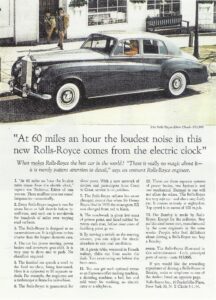
“At 60 miles an hour the loudest noise in this new Rolls-Royce comes from the electric clock”*
It’s a classic.
Not the car – the ad.
It’s very much benefit-driven. But not in an obvious way.
The headline is direct and practical. It plays directly to the selling proposition – this car offers a more refined, more luxurious experience.
Well, you’d expect that, it’s Rolls-Royce.
And because we all expect it, a headline that talks about luxury wouldn’t be very interesting.
But by highlighting a simple, unexpected detail, Ogilvy makes us stop and consider what he has to say.
And not only does he grab our attention, he does it in a way that allows us to imagine at least part of the experience of owning such a fine motor vehicle.
An unusual but tangible benefit, that paints a picture of superior engineering and attention to detail.
Clever.
Simplicity matters
The Rolls-Royce ad is an excellent example of simplicity in advertising. It’s not that the headline is short and sweet. In fact, it’s quite a long headline – but that’s not the point.
The important thing to consider here, is that the headline is incredibly single-minded.
It focuses on one thing only.
And it focuses on something that most people can understand.
The writer could have talked about all sorts of features that make the car what it is. In fact, the rest of the ad does exactly that.
But we all know what a ticking clock sounds like. We can all imagine the sound.
And it’s very specific.
It’s not just a clock. It’s an electric clock. Which (we presume) is even quieter.
The engine is quieter than the electric clock?
Wow, that’s a quiet engine.
Specificity matters because it creates a really clear picture of what the writer wants us to see (or hear); the scenario in our mind becomes real, believable.
So what makes a good headline?
I’d love to be able to give you a formula.
But there isn’t one.
Creativity isn’t easy to bottle.
There are, however, some principles of construction to consider that tend to underpin successful headlines:
- Be clear before clever
Wordplay can be interesting, fun and even memorable. But effective headlines are easy to understand. Make sure the message is obvious and accessible to your audience. - Specificity matters
Generalities don’t sell. The more specific a headline is, the more believable and compelling it usually is. Think, “this car is really fast” versus “0-60mph in less than three seconds”. - Keep it tight
Concise, punchy and to the point. Respect the reader’s time and remember attention spans are short. Make the headline as short as you can, whilst saying all that you want to.
But just because there some principles to consider, doesn’t mean you have to follow them. And remember, the headline doesn’t (usually) work in isolation of the rest of the ad. Visuals speak a thousand words, or so your average art director would have you believe – and there are countless examples of advertising where the headline is virtually non-existent.
But take this next idea as an example. Arguably, it doesn’t need a visual at all.
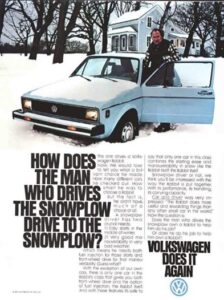
The line “How does the man who drives the snowplow drive to the snowplow?” creates a really clear visual image. We can picture the scenario in our minds, we can see it.
And whilst the benefit is not explicit in the headline, our thoughts will very quickly fill in the gaps to conclude that this is a pretty robust car.
Here’s another really good headline, Again you could argue that the image here is superflous (brands feel more comfortable when they show the product);

What’s important about the headline is that it evokes a feeling. We can all easily imagine what it’s like to have wet feet. It’s familiar to us, and we don’t like it. Our socks could be as dry as a bone when we see this, and we’ll still want to go and dry our feet.
And then there’s this classic from Avis.
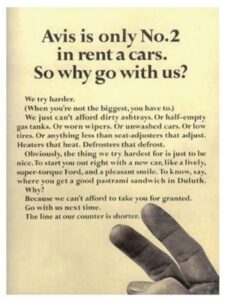
A masterstroke in positioning, this question turned Avis’s number two status in the market into a competitive advantage.
The answer, “We try harder”, made it simple for the customer to make a connection between a simple truth and a clear reason why their service would be better. It’s easy for us to believe that the underdog tries harder.
The psychology of persuasion
The effectiveness of a headline largely hinges on its ability to tap into human psychology. The headlines themselves don’t have to do all the selling. What the headline does need to do is to persuade the reader to read on.
Whether it’s a classic print ad, social media post, outdoor poster or direct mail pack, if you fail to get the reader’s attention quickly, you’ve lost.
3 ways to get attention
- Promise a benefit: As Ogilvy himself noted, the most effective headlines promise the reader a specific benefit. Whether it’s saving time, gaining status, improving health, or promising happiness – successful headlines usually tap into the desires, needs or pain points of their audience.
- Provoke curiosity: Humans are naturally curious. Headlines that pose a question or suggest mystery, engage the reader’s inherent desire to learn more. The key is to balance the information given with the information withheld – enough to intrigue but not enough to satisfy.
- Evoke emotions: A headline that triggers an emotional response is more likely to be memorable. Think fear, joy, sadness or anxiety. Or wet feet.
Clearly there are foundational principles and techniques that can guide the creation of effective headlines – but in reality, the art itself remains highly contextual and nuanced.
It may be possible to explain great headlines logically and scientifically, but ultimately, great headline writers just understand people – their drivers, their fears, their hopes. They know how to provoke curiosity, they know how to turn the mundane into magic. They get how to take something that’s perhaps been overlooked and turn it into something that we can’t do without.
The secret to writing great headlines?
It’s called creativity.
And there’s no formula for that.
*For the purposes of this article we’re not going to worry about the fact that David Ogilvy didn’t actually write the headline. He openly admits that it was lifted from a motoring magazine’s review of the Silver Cloud. But it was Ogilvy who spotted why it made a great headline. It’s genius.
