

Your website has the potential to be your best salesperson.
It doesn’t sleep. It doesn’t stop for lunch. It doesn’t charge expenses. And it doesn’t moan that marketing isn’t giving them any leads.
Plus, it can reach more prospective customers in a week than your entire sales team could in a year.
But is your website really pulling its weight?
Or is it plain lazy? Just a passive brochure that sits happily on its digital shelf, talking to no-one?
If your site isn’t bringing in leads, helping to nurture interest, or at least giving your brand some credibility in a competitive market, then it’s not just underperforming – it’s actively wasting opportunities.
If you want your website to fulfil its potential, you’ll need to be brutally honest about what’s working, and what’s not.
Here are seven signs your B2B website needs a rethink – and what to do about it.
1. You’re embarrassed to share the link
In B2B, where trust and credibility are everything, your website makes an important first impression. A tired-looking website signals a tired business. If it doesn’t look sharp, customers won’t think you are.
If your first instinct is to say, “Ignore the website, it’s a bit out of date”, or if your salespeople don’t share pages, don’t reference it in conversations, or don’t believe it helps them win deals – then that should be a red flag for you.
Over time, businesses evolve, your value proposition changes, audiences change behaviour. Your website needs to keep up. If your website is obviously out of date, fix it now.
2. You look, feel, and sound like everyone else
If you strip out your logo, could your website belong to any of your competitors?
Be honest.
Is your website just wallpaper?
If it’s too safe, too familiar – then it’s also very forgettable.
Time for a change.
3. Your value proposition is nowhere to be seen

When prospective customers land on your site, is it immediately obvious what you do, who you do it for, why you’re different from the competition – and why that matters?
Here’s a clue – if your homepage headline reads “Welcome to <insert name here>”, then you’ve already missed an opportunity to stand out.
It’s like answering the phone by stating the number the caller has dialled.
The chances are you’ve buried your proposition too deep in the site. Or worse – you haven’t even begun to articulate why you’re different.
If that’s you, then at the very least, your homepage headlines and hero copy need a rewrite. But you might need to go deeper and develop a clearer market positioning.
4. You’re invisible on Google
If your competitors show up on search engines and you don’t, then you’re allowing them a competitive advantage over you.
Your site might look great, but if it’s not built with SEO in mind, no one’s finding it. It’s like having a beautiful showroom that’s hidden on a sprawling industrial estate miles away from passing traffic and footfall.
You might need a rethink.
5. You’re getting traffic, but zero conversions
You might be spending money on SEO, PPC or content. You might be getting traffic but if there’s no persuasive messaging and no clear journey, your visitors are left standing at the entrance, with no signposting, not knowing what they’re expected to do next.
Decent traffic but non-existent leads suggest that your site has unclear calls to action, a weak proposition or clunky user journeys.
If you want your site to convert, you need to design it that way.
6. Your site is written for you, not the customer
Does your site talk endlessly about your history, your mission, your services? Do you talk about your products and features without mentioning the customer’s world?
B2B buyers aren’t looking for a list of what you have to sell. They’re looking for proof that you understand them. Their pain. Their risk. Their world.
They want to know you can solve their problems.
Don’t allow your website to become self-indulgent.
7. It’s a pain in the a$$ to update

Do you need a degree in computer programming just to change a phone number? Are you finding it impossible to swap out an image for something more up to date?
You shouldn’t need a developer to make simple changes.
If you’re working with legacy tech, you need to upgrade to a CMS that puts you in control.
So where do you start?
Think strategically. Here are 10 top tips to help you do that.
- Define your objectives. What are you building the site to do? Is it for lead generation? Sales conversion? Investor credibility? Recruitment? All of these? Most B2B websites fail because they’re built without a clear and REALISTIC commercial goal.
- Understand your audience. Remember that your website isn’t for you – it’s for your visitors. So map out your primary audience segments – and create personas for your top three:
- Who are they? (Job title, industry, seniority)
- What problems are they trying to solve?
- What questions do they ask before buying or taking the next step?
- What would make them trust you?
- Think about what they want to do on your site, against what you want them to do.
- Define your value proposition. What do you do, who do you do it for, and why should they choose you? Create a clear positioning statement with a compelling narrative that tells the story you want them to understand about you. Do try to say something different than your competitors and include proof points.
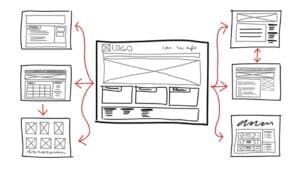
- Structure the site around their journey. Forget about the way you’ve structured your business – the structure should reflect the way your core audiences move through their decision-making process. Make sure it’s easy for them to immediately understand who you are, the problems you solve, and the solutions or services you provide, as well as providing links to deeper pages with more detailed, supporting information.
- Plan for search visibility (SEO). Make sure you’re ranking for keywords that your buyers use when searching for suppliers and structure your pages around these terms. Be sure to use clean URL structures and clear headings.
- Write persuasive, buyer-focused copy. Remember you’re writing to persuade your visitors to take the next step. To do that you need to talk their language, and show that you understand their world, their problems. Explain how you can help them and provide proof points like case studies, testimonials and statistics. And always provide a clear call to action – let them know what to do next.
- Design with simplicity in mind. Your website doesn’t have to be flashy. Make sure you prioritise a clear message hierarchy that’s easy to scan. And make sure you’re designing for devices that your prospective customers use for research – whilst mobile-first is a decent mantra, remember that many B2B buyers will be working from desktops.
- Build your site on a flexible, marketing-friendly CMS. You need to make it easy for the marketing team to edit copy, add pages and tweak layouts without having to get the developers in. Think WordPress with a proper theme builder, and you won’t go far wrong.
- Make sure you include appropriate conversion infrastructure. Remember you’re looking to get visitors to take the next step, so think about where each of your personas might be on their buying journey. Do you want them to book a call, ask for a quote, download a guide, or watch a webinar? Do you have landing pages for specific campaigns? Can you create smart forms that link to your marketing automation systems?
- Launch and learn. A website is never ‘finished’. Once you’ve launched, you’ll need to assess performance and build on your learnings. Remember to keep adding content to help feed SEO. Review user journeys via heatmaps and session recordings (e.g. Hotjar) and A/B test critical pages. Set up a dashboard tracking traffic, conversions, popular content and user behaviours.
Always remember this
A website isn’t a project. Projects end.
You review your staff performance on a regular basis – the same principle should apply to your website. If you want a website that works for you, you’ve got to keep working on it.
No website is ever perfect, so don’t wait for the stars to align. Treat your website like you’d treat any other business-critical tool. Build it around real user needs, adopt a continuous improvement mindset – and keep refining.
)